There’s a moment every decade when a technology stops being “emerging” and simply becomes the way things work. For television, that moment arrived quietly but decisively sometime around 2024 — and by 2026, there’s no going back. IPTV subscriptions are no longer a niche alternative to cable. They are cable’s replacement, the broadband bundle’s anchor, and for millions of households worldwide, the only screen experience that matters.
Twenty years ago, I was writing copy for satellite dish companies trying to convince homeowners that a dish on the roof was somehow liberating. Today, I’m watching that same industry completely reinvent itself through internet-protocol delivery — and the marketing challenge has never been more nuanced, or more exciting.
This guide breaks down everything you need to understand about the current IPTV landscape: the technical infrastructure that powers it, the market forces shaping its growth, the very real consumer safety risks lurking in its shadows, and the strategic frameworks that separate services worth subscribing to from those that will waste your money or compromise your device.
Table of Contents
Why 2026 Is a Defining Year for IPTV Subscriptions
The numbers tell a story that no cable executive could have predicted two decades ago. Nearly 91% of U.S. internet households now use at least one subscription streaming service. The American subscription video market alone has grown into a $147 billion economy. On average, a single household now juggles 6.1 different video services and spends roughly $103 per month keeping them all active.
That figure — $103 per month — is significant. It’s not dramatically lower than what people used to pay for cable bundles. What has changed is the nature of the relationship between viewer and provider. Consumers now hold the power. They subscribe, they cancel, they re-subscribe for a single season, and they move on. This behavioral shift has turned subscriber retention into the defining operational challenge of the streaming era.
For anyone evaluating IPTV subscriptions in this environment, understanding the technical and commercial forces at play is no longer optional. It’s the difference between making smart choices and getting burned.
The Technical Foundation: IPTV vs. OTT — Why It Matters
Let’s get one critical distinction out of the way early, because it affects everything from picture quality to pricing to reliability.
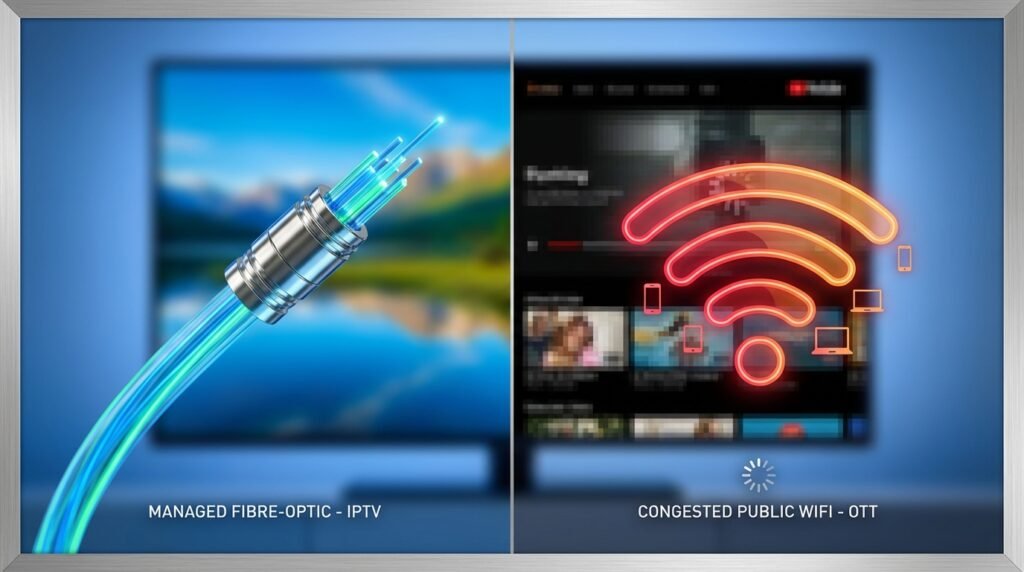
IPTV delivers multimedia content — video, audio, and data — over private, managed IP-based networks. The operator controls the full delivery path, which means they can prioritize traffic, guarantee bandwidth, and maintain Quality of Service (QoS) at a level that public internet services simply cannot match.
OTT (Over-the-Top) services, by contrast, ride on the unmanaged public internet. Netflix, Disney+, and most streaming apps you’re familiar with fall into this category. They’re brilliant at what they do, but they have no control over the last mile of delivery between their servers and your screen.
The practical consequences of this difference are most visible during live events. Standard OTT live streams often carry between 5 and 30 seconds of latency — which is why you sometimes hear your neighbor’s celebration before you see the goal. Managed IPTV subscriptions on private networks routinely achieve sub-second latency. For sports fans, that’s not a minor technical detail; it’s the entire point.
Another architectural advantage is multicast distribution. In a managed IPTV environment, a single data stream can simultaneously serve every viewer watching the same live channel. Bandwidth costs can drop by up to 90% compared to OTT’s unicast model, where every viewer requires their own dedicated stream. For operators, this efficiency translates directly into better pricing and reliability for end users.
The Churn Crisis and What It Means for Consumers
If you’ve cancelled a streaming service in the last twelve months, you’re not unusual — you’re average. Annualized churn rates across the streaming industry now exceed 30%, and industry analysts have largely stopped treating this as a problem to be solved. It’s simply the new normal of consumer behavior.
This volatility has reshaped how operators structure iptv subscriptions at every level. The most forward-thinking providers have moved toward converged platforms that manage both managed IPTV and unmanaged OTT audiences from a single back-office system. These platforms allow ISPs and telcos to leverage existing broadband relationships to bundle video services — using IPTV as the “sticky” layer that makes households less likely to churn from their internet provider as well. Research suggests that bundled IPTV subscriptions of this kind can reduce overall household churn by up to 35%.
For consumers, the practical implication is straightforward: bundles genuinely do save money and reduce friction. The challenge is finding providers transparent enough to offer them honestly.
Ad-Supported Tiers, Hybrid Models, and What You’re Actually Paying For
The economic pressure on streaming households has produced a fundamental shift in how iptv subscriptions are priced and packaged. Approximately 69% of U.S. internet households now use at least one ad-supported streaming tier. The willingness to watch ads in exchange for lower monthly costs has become a mainstream behavior, not a compromise made by budget-constrained viewers.
This has pushed providers to engineer increasingly sophisticated hybrid business models:
Premium SVOD (Subscription Video on Demand) remains the flagship offering for providers committed to ad-free viewing. These tiers carry higher price points but attract the most loyal, high-value subscribers.
FAST Channels (Free Ad-Supported Streaming TV) have exploded in popularity as low-barrier entry points. These channels function like traditional broadcast TV — always on, always free — but delivered digitally and monetized through advertising.
vMVPDs (Virtual Multichannel Video Programming Distributors) serve the significant audience that still wants traditional channel bundles but doesn’t want to deal with a physical cable infrastructure. Services like YouTube TV and Hulu Live TV fall into this category.
The aggregation of these models under a single platform is where the most innovative operators are competing right now. Rather than forcing consumers to manage multiple apps, the strongest IPTV subscriptions bring everything into a single curated interface, simplifying discovery and building the kind of habitual engagement that reduces churn organically.

Live Sports: The Acquisition Engine That Keeps on Running
No content category drives iptv subscriptions quite like live sports. Rights deals with major leagues remain the single most powerful subscriber acquisition tool available to any platform, and the competition for those rights has become genuinely intense.
The fragmentation of sports rights across multiple services has become a primary frustration for fans — but it’s also one of the most reliable subscription drivers in the industry. Research consistently shows that approximately 60% of sports viewers have subscribed to a new service specifically to watch a single event or access a league pass. That’s an extraordinary level of content-driven motivation.
Younger demographics, particularly viewers aged 18 to 34, are also demanding something beyond passive viewing. Over 80% of sports fans in this age bracket have used interactive features while watching live content — real-time statistics, multi-angle viewing, social chat overlays, and in-game engagement tools. The most sophisticated iptv subscriptions are already building these capabilities directly into their interfaces.
For UK sports fans in particular, the challenge of tracking down live football, cricket, and rugby across multiple providers has become genuinely complicated. If you’re navigating that landscape, our dedicated guide on how to watch Premier League on IPTV UK covers everything you need to know about accessing top-flight football legally and reliably through IPTV. The rights situation changes frequently, and having a clear, up-to-date reference matters.

Consumer Safety: Separating Legitimate Providers from Dangerous Frauds
This section carries more weight than any other in this guide, and I want to be direct about why.
As demand for IPTV subscriptions has grown, so has the ecosystem of fraudulent providers offering impossibly cheap access to premium content. These services are not merely illegal — they are actively dangerous to the devices and data of anyone who uses them.
Research conducted by Bournemouth University found that 32 out of 60 tested illicit IPTV URLs were classified as malicious. These sites routinely use malvertising — malicious advertising embedded within their interfaces — to redirect users to landing pages distributing ransomware or cryptocurrency-mining software. Security researchers have identified specific malware tactics operating within these environments, including techniques designed to map a victim’s device for further exploitation.
Identifying a legitimate provider requires attention to a few concrete signals:
Verifiable business information is the first checkpoint. Any legitimate IPTV provider should have a clear legal address, contactable customer support, and transparent subscription terms published on their official website. If that information is absent or vague, walk away.
Documented content partnerships matter enormously. Legitimate services have licensing agreements with studios and content owners. They can name their partners. Fraudulent services cannot.
Transparent pricing without deceptive structures is the third marker. Unusually low prices, “lifetime” subscription offers, and payment structures that require cryptocurrency or gift cards are reliable indicators of fraud.
If you’re in the UK and actively comparing options, our Best IPTV UK guide evaluates current providers across these criteria in detail, covering pricing, reliability, content libraries, and the licensing status of their offerings. In a market this crowded, having a reference point built on actual due diligence saves both money and risk.
Subscriber Lifecycle Management: The Business Engine Behind Every Platform
From an operator’s perspective, iptv subscriptions live and die on subscriber lifecycle management. This is the operational discipline that begins the moment someone signs up — increasingly through Single Sign-On options using Google or Apple credentials — and extends through every interaction until the moment they cancel, or ideally, never do.
Modern subscriber management platforms track viewing patterns, feature engagement, and behavioral signals to build predictive models of churn risk. When those models flag a subscriber as “at risk,” automated retention campaigns can trigger personalized content recommendations, temporary pricing adjustments, or loyalty reward notifications. Operators who have implemented these systems report reductions in churn rates of up to 25% compared to reactive approaches.
There is also an important regulatory dimension here that consumers should understand. Most jurisdictions with significant IPTV markets now enforce Automatic Renewal Laws requiring providers to clearly disclose renewal terms before enrollment, obtain explicit consumer consent, and offer a straightforward cancellation mechanism. Platforms that bury cancellation options or make renewal terms difficult to locate are not just behaving unethically — in many markets, they’re breaking the law.
When evaluating iptv subscriptions, the cancellation process is worth testing early. A service that makes it easy to leave is generally one that’s confident enough in its quality to compete on merit.
Hardware in 2026: Smart TVs, IPTV Players, and the Platform Wars
The television set itself has undergone a quiet revolution. Smart TVs are now present in 68% of U.S. internet households, and these devices have evolved far beyond simple streaming boxes. They are commerce platforms — 42% of Smart TV owners have made a purchase directly through their TV interface — and increasingly, data collection endpoints for OS vendors competing for advertiser attention.
The dominant TV operating systems — Roku, Samsung’s Tizen, and Amazon’s Fire OS — function as gatekeepers for app placement and audience access. For providers of IPTV subscriptions, earning prominent placement on these platforms is a critical distribution priority. For consumers, it’s worth understanding that these OS vendors have commercial interests that shape which apps get featured and how.
For users who prefer granular control over their viewing experience, third-party software players remain an excellent option. The leading choices in 2026 include:
TiviMate consistently earns high marks for its interface design and advanced feature set, including Picture-in-Picture viewing and custom recording configurations. Power users tend to gravitate here.
IPTV Smarters has maintained its popularity through simplicity and reliable multi-screen support. If you’re new to third-party players and want something that works without configuration complexity, this is a sensible starting point.
XCIPTV is widely regarded as one of the best free options for Fire TV and Android devices, combining performance with a clean user experience.
An important clarification on legality: all three of these applications are entirely legal to install and use. They are video players, nothing more. Their safety profile depends entirely on the legitimacy of the M3U playlists or Xtream Codes credentials provided by the iptv subscriptions they’re paired with. Legal player plus illegal content stream equals legal exposure and security risk. The player itself is never the problem.
AI Integration and the Authenticity Question
Artificial intelligence has become a practical tool across the iptv subscriptions ecosystem, primarily in ways viewers don’t consciously notice. AI-powered video upscaling improves picture quality on older content. Automated caption generation and multilingual translation expand accessibility. Engagement analytics help operators understand what’s working and surface it to the right audiences at the right moments.
Where AI integration has encountered resistance is in content creation itself. Research suggests that 40% of consumers are less likely to engage with content explicitly labeled as “AI-created,” with concerns centered on a perceived loss of human creativity and editorial judgment. For platforms built on IPTV subscriptions, the takeaway is clear: AI performs best when it operates invisibly, improving the experience without announcing itself.
The platforms that will win long-term are those treating AI as infrastructure — something that makes the service faster, smarter, and more reliable — rather than as a content strategy or a marketing point.
The Converged Future: Broadband, Video, and the Connected Home
The direction of travel is unmistakable. The companies positioned to dominate iptv subscriptions over the next five years are those that can bundle managed IPTV with broadband services, creating a household infrastructure that’s genuinely difficult to replace.
ISPs and telcos are already executing this strategy. By treating video as the anchor of a broader connected home service — rather than as a standalone product — they’re creating the kind of multi-layered relationship with customers that individual streaming services simply can’t replicate. When your internet, television, and home security all come from the same managed network, the friction of switching any one of them is considerably higher.
For consumers, this convergence offers real advantages: more reliable delivery, simpler billing, and increasingly, better pricing through bundled packages. The challenge is ensuring that competitive pressure remains strong enough to keep those bundles genuinely fair. In markets where a single ISP holds significant leverage, regulatory scrutiny of IPTV subscriptions bundling will remain important.
Practical Guidance for Choosing IPTV Subscriptions in 2026
After twenty years of writing about technology markets, the framework I keep returning to for evaluating IPTV subscriptions is simpler than most industry analysis suggests:
Legality first, always. The security risks associated with fraudulent providers are not theoretical. They are documented, they are serious, and no price discount is worth them.
Verify before you subscribe. A provider that can’t tell you who they are, who their content partners are, or how to cancel isn’t a provider you want to trust with your payment information.
Understand what you’re buying. Managed IPTV and OTT streaming have different performance profiles. If sub-second live latency matters to you — and if you’re a sports fan, it should — make sure the service you choose is delivering through a managed network, not just routing content through the public internet with a different logo.
Read the renewal terms. Every time. Without exception. The number of consumers caught off guard by automatic renewals in this space remains remarkably high.
The IPTV subscriptions market in 2026 rewards informed consumers far more generously than it did five years ago. Competition is real, content quality is high, and the technical infrastructure has matured to a point where excellent viewing experiences are genuinely accessible at reasonable price points. The opportunity is there — as long as you approach it with clear eyes.
Looking for a curated breakdown of the top options available right now? Our Best IPTV UK guide covers the leading providers across content quality, pricing transparency, and reliability. And if football is your primary motivation for exploring IPTV, the complete guide on how to watch Premier League on IPTV UK has everything you need to follow the action legally and without frustration.