Let’s be brutally honest: the cost of TV in the UK has become something of a national scandal. While the cost-of-living crisis continues to squeeze household budgets from every conceivable direction — energy bills, mortgage rates, the weekly shop — the major broadcasters have decided that 2026 is the perfect time to pile on even more pressure. Sky raised its prices again in February, with some packages climbing by as much as £43 per year. Virgin Media followed suit not long after, quietly bumping its bundles upward and hoping loyal customers simply wouldn’t notice. For millions of British households already stretched thin, these hikes feel less like a business decision and more like a betrayal. And it’s precisely why the conversation around IPTV subscription services — and specifically what IPTVStreamy’s Level Up proposition offers — has never been more relevant.
Table of Contents
The Great British Telly Rip-Off
To understand why so many savvy consumers are making the switch, you need to stare down the numbers without flinching.
A standard Sky Stream package with Sky Sports and Sky Cinema in 2026 will set you back approximately £65–£75 per month depending on your contract. Add BT Sport (now TNT Sports) via a broadband bundle and you’re looking at another £20–£30 on top. Factor in Netflix — which most households keep regardless — at £17.99 per month for the Standard with ads-free tier, and you’ve quietly assembled a television bill that reads like a mortgage payment.
Let’s do the maths properly:
| Service | Monthly Cost | Annual Cost |
|---|---|---|
| Sky Stream (inc. Sky Sports + Cinema) | £70 | £840 |
| TNT Sports (via BT broadband add-on) | £25 | £300 |
| Netflix (Standard) | £18 | £216 |
| Total | £113 | £1,356 |
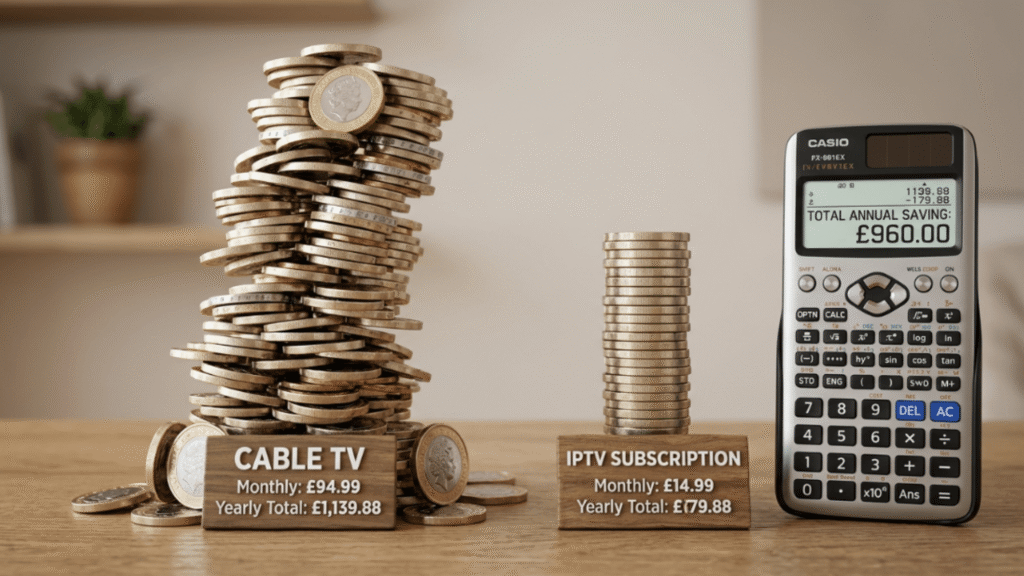
Over thirteen hundred pounds. Per year. For telly.
That figure isn’t a fringe case — it’s what a typical sports-loving, film-watching British household is spending in 2026 on the privilege of watching content they’ve already technically paid for via the licence fee. And that’s before you’ve touched Amazon Prime Video, Disney+, or the Apple TV+ subscription that came bundled with your phone upgrade and quietly auto-renewed.
Sky and Virgin Media have long relied on the same psychological trap: the introductory offer. Sign up for eighteen months at £39 per month, watch that price silently double at renewal, and by the time you’ve noticed, inertia has done its job. Cancelling feels like admin. Re-negotiating feels like a confrontation. And so the direct debit rolls on, month after month, draining money that British families simply cannot afford to waste right now.
Enter the Smart Alternative
This is where the landscape has fundamentally shifted. A premium IPTV subscription — and not the dodgy, buffering-every-five-minutes variety that gave the category a bad name — now represents a genuinely compelling alternative for households who want quality without the eye-watering price tag. To see which providers made our top list this year, make sure to check out our expert review of the Best IPTV UK services available for 2026.
A reputable IPTV service in 2026 typically costs anywhere between £8 and £20 per month, depending on the tier and provider. That’s a fraction — sometimes less than a fifth — of what Sky charges for a comparable content library. For the maths-minded among you:
| Service | Monthly Cost | Annual Cost |
|---|---|---|
| Premium IPTV Subscription | £15 | £180 |
| Netflix (Standard) | £18 | £216 |
| Total | £33 | £396 |
You’ve just freed up nearly £1,000 per year. That’s a family holiday. That’s five months of energy bills. That’s the difference between financial breathing room and financial stress.
But here’s the nuance that often gets lost in these comparisons: not all IPTV services are created equal. The market has historically been plagued by providers who over-promise — “10,000 channels!” — and dramatically under-deliver, offering pixelated streams, frequent outages during the very matches you’ve been waiting all week to watch, and customer support that amounts to a single, slow-responding Telegram handle. If you’ve been burned before, the scepticism is entirely warranted.
Level Up: Quality That Matches the Saving
This is precisely the gap that IPTVStreamy’s Level Up proposition was built to fill — and it’s worth understanding why the name matters.
“Level Up” isn’t merely a marketing strapline. It’s a philosophy that challenges the assumption most British consumers have unconsciously accepted: that saving money on TV means compromising on the experience. IPTVStreamy has built its reputation on proving that premise wrong.
The Level Up tier delivers full 4K Ultra HD streaming across its content library — live sport, box sets, films — with the kind of stability that allows you to actually trust it on a Champions League night or during a six-nations grand slam. We’re talking anti-freeze technology, dedicated server infrastructure that doesn’t buckle under demand, and an Electronic Programme Guide (EPG) that genuinely behaves like one, rather than a disorganised list that refreshes every forty minutes.
The user interface matters too. One of the quiet frustrations of the traditional IPTV market has been that cheap services look cheap — clunky navigation, confusing menus, and a general aesthetic that screams “this was built in an afternoon.” Level Up addresses this directly, offering a clean, intuitive interface that works seamlessly across Smart TVs, Fire Sticks, Android boxes, iOS devices, and MAG boxes. It’s the kind of cross-device flexibility that Sky charges a premium for and still doesn’t always deliver gracefully.
What IPTVStreamy has understood — and this is the crux of the Level Up argument — is that British consumers in 2026 are not simply looking for cheap. After years of cost-of-living pressure, they’re looking for smart. They want to feel that they’ve made an intelligent decision, not a desperate one. Saving £960 per year while watching Premier League football in crystal-clear 4K on their 65-inch television isn’t a downgrade. It’s an upgrade. It’s levelling up.
Why a Cheap IPTV Subscription is Often a False Economy
There’s a particular kind of buyer’s regret that’s unique to the budget end of the IPTV market. It usually hits at 87 minutes, when your team is pushing for an equaliser and the stream freezes solid — buffering wheel spinning, audio cutting out, the moment gone forever. Or it arrives on a Sunday morning when you realise the support email you sent three days ago has vanished into the void. This is the reality of the £3-per-month IPTV subscription, and it’s worth examining honestly before any household makes the switch.
The rock-bottom end of the market is awash with providers operating from unidentifiable locations, running overcrowded servers on shoestring infrastructure, and disappearing entirely every few months only to resurface under a slightly different name. Their pitch is always the same: an absurd channel count (50,000 is a number that gets thrown around with alarming confidence), a price that seems too good to be true, and payment methods that conveniently offer no recourse if everything goes sideways. For the uninitiated, it’s an easy trap. A £3 monthly outlay feels essentially risk-free. What’s the worst that could happen?
Quite a lot, as it turns out.
Beyond the obvious frustration of unreliable streams, there are subtler costs that accumulate quietly. Your time spent troubleshooting — restarting devices, clearing caches, reinstalling apps, hunting through Reddit threads for fixes — has a value. The experience of watching sport under the constant low-level anxiety of whether the stream will hold is a tax on your enjoyment that doesn’t show up in any price comparison. And when the provider inevitably vanishes mid-season, taking your subscription payment with them, that £3 per month suddenly looks rather less like a bargain.
A professional IPTV subscription from a provider like IPTVStreamy operates in an entirely different register. The infrastructure is built to handle concurrent demand — tens of thousands of users watching simultaneously during peak events without the servers groaning under the weight. Uptime commitments are real rather than aspirational. And critically, when something does go wrong, there is an actual human being available to help you fix it.
The Hardware Factor: Completing the Level Up
Here’s something the conversation around IPTV subscriptions rarely addresses with sufficient seriousness: the device you use matters enormously.
Even the most premium IPTV subscription will underperform on ageing or underpowered hardware. If you’re still running an application on a first-generation Fire Stick from 2019 or an Android box that cost £15 from a marketplace seller, you are introducing a bottleneck that no amount of server-side quality can compensate for. Buffering issues that owners blame on their IPTV service are frequently, in reality, a hardware problem.
The Amazon Firestick 4K Max is the entry-level recommendation for anyone serious about the Level Up experience. For readers making this transition, IPTVStreamy provides a comprehensive guide on how to set up IPTV on Firestick, walking through the process from first install to optimal settings configuration. It’s the kind of practical resource that underscores the difference between a professional operation and a fly-by-night provider.
For those who want the absolute ceiling of home streaming performance, the Nvidia Shield Pro remains the gold standard. Its processing power is genuinely overkill for most use cases — which is precisely the point. It upscales lower-resolution content intelligently, handles 4K HDR10+ natively, and runs cooler and quieter than any Amazon device. If you are making the commitment to build a proper home cinema setup around a quality IPTV subscription, the Shield is the centrepiece it deserves.
For readers making this transition, IPTVStreamy provides a comprehensive guide on how to set up IPTV on Firestick, walking through the process from first install to optimal settings configuration. It’s the kind of practical resource that underscores the difference between a professional operation and a fly-by-night provider — genuine aftercare rather than simply taking your money and wishing you luck.
Premium Features That Justify the Investment
When IPTVStreamy describes Level Up as a premium IPTV subscription, the word “premium” is carrying genuine weight rather than serving as a synonym for “more expensive.”
The 4K sports offering is perhaps the most immediately compelling feature for the British viewer. Premier League matches, Formula 1 qualifying sessions, Ryder Cup coverage — all delivered in Ultra HD with HDR colour grading where the broadcaster supports it. On a modern television, the difference between standard HD and genuine 4K sports content is not subtle. It’s the kind of visual clarity that makes you question why you ever tolerated anything less.
Then there’s the Anti-Freeze technology — IPTVStreamy’s proprietary buffer management system that maintains stream continuity even when your home internet connection experiences the minor fluctuations that are an unavoidable fact of broadband life in the UK. Rather than letting a momentary dip in bandwidth translate into a frozen screen, the system absorbs the interruption and recovers seamlessly. It’s the technical solution to the single biggest frustration in IPTV streaming, built directly into the service rather than left for the user to manage through workarounds.
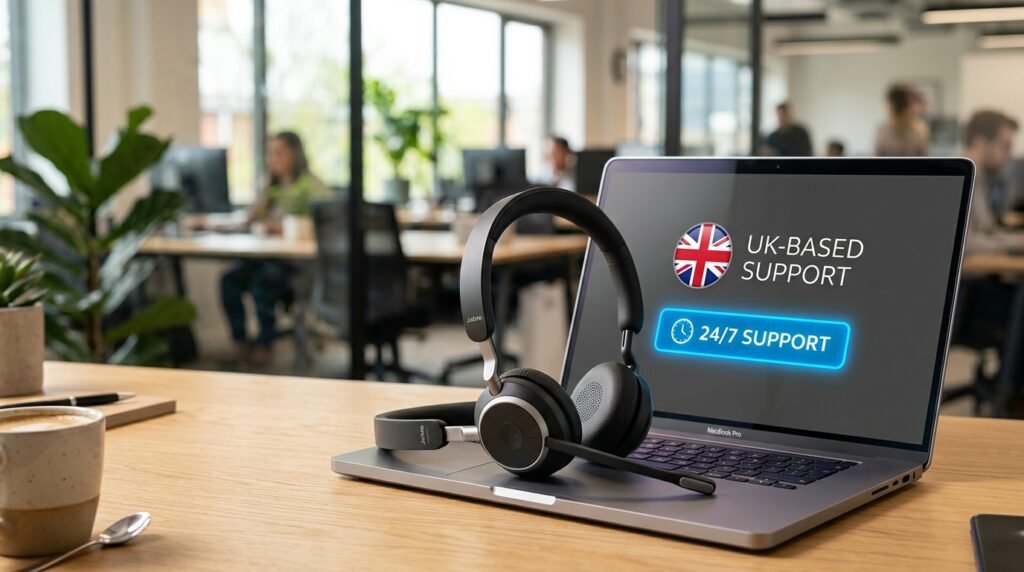
The 24/7 UK-based customer support deserves particular emphasis in this context. Support that operates within your time zone, understands the specific quirks of British broadband infrastructure, and can walk you through a fix during Saturday lunchtime kick-off rather than promising a response within 72 business hours is not a minor convenience — it’s a meaningful differentiator. For households replacing Sky or Virgin Media, this level of responsiveness is actually an improvement on what the established providers typically offer, where call waiting times are measured in geological epochs and live chat agents frequently have no resolution authority whatsoever.
The combination of these features — 4K picture quality, Anti-Freeze stability, responsive support, and polished hardware compatibility — is what transforms an IPTV subscription from a cost-cutting measure into a genuine upgrade. This is the Level Up argument made concrete: you are not accepting a lesser experience in exchange for paying less. You are accessing a better one.
Here’s the final section of your article:
The Annual Subscription Advantage: Save 50% by Thinking Long-Term
One of the quietest financial wins available to any household making the switch is one that IPTVStreamy makes remarkably straightforward: pay annually, not monthly.
The mathematics are stark. A premium monthly IPTV subscription, billed one month at a time, carries the convenience premium you’d expect — flexibility costs money, and providers price accordingly. Switch to an annual commitment and IPTVStreamy’s Level Up tier drops by approximately 50% on a per-month basis. Across twelve months, that difference compounds into a saving that, when stacked on top of the money you’ve already freed up by leaving Sky or Virgin Media, starts to feel genuinely transformative for a household budget.
There’s a behavioural argument here too. Monthly billing keeps you perpetually in evaluation mode — a minor frustration, a single bad stream, and the cancellation option is always one click away. Annual billing invites you to actually settle in, optimise your setup, and extract full value from what the service offers. It’s the difference between renting and owning the experience. And for a service as stable and feature-rich as Level Up, that commitment is rewarded rather than punished.
The annual IPTV subscription also provides protection against price drift. Monthly rates can shift with relatively little notice; an annual contract locks in today’s pricing for a full year, insulating you from the kind of mid-cycle increases that Sky has made something of an art form.

Check Your Line Before You Commit: The SpeedNord.com Test
Before purchasing any IPTV subscription, you should verify that your home broadband connection can actually deliver the experience you’re paying for. SpeedNord.com is the tool IPTVStreamy recommends for this purpose, and it’s the one we’d point any prospective subscriber toward before making a purchasing decision.
4K streaming requires a sustained download speed of at least 25 Mbps, with 50 Mbps recommended for households running multiple streams simultaneously or using Wi-Fi rather than a wired ethernet connection. The theoretical speeds quoted on your broadband contract are rarely what arrives at your router during peak evening hours, and a connection that manages 4K on a Tuesday afternoon may struggle on a Saturday at 3pm when half the street is simultaneously watching football.
SpeedNord.com is the tool IPTVStreamy recommends for this purpose, and it’s the one we’d point any prospective subscriber toward before making a purchasing decision. Unlike some speed testing tools that route through artificially optimal servers, SpeedNord.com provides a realistic picture of your line quality — measuring not just raw download speed but latency and connection stability, which are equally important for live streaming. Run the test at the time of day you’d typically be watching. If your results comfortably clear 50 Mbps with low latency, you are set up for a genuinely premium 4K experience. If they don’t, that’s valuable information that might point toward a broadband upgrade before — or alongside — your IPTV switch.
Frequently Asked Questions
Can I use one IPTV subscription on two TVs?
IPTVStreamy’s Level Up plan includes multi-connection support, meaning you can run the service on more than one device simultaneously. The exact number of concurrent streams depends on the plan tier you select — details are available on the pricing page — but households with multiple televisions are well catered for without needing to purchase separate subscriptions for each screen.
Is there a free trial available?
Yes. IPTVStreamy offers a trial period that allows you to test the service — including stream quality, channel availability, and the EPG — before committing to a paid IPTV subscription. This is the responsible way to approach any streaming service purchase, and the fact that IPTVStreamy offers it speaks to their confidence in what Level Up delivers. A provider that won’t let you test the product before you buy it is telling you something important.
Will I be tied into a contract?
No long-term contracts are imposed on subscribers. Monthly plans offer complete flexibility — cancel at any time without penalty. Annual plans require the upfront commitment to unlock the 50% saving, but there are no rolling tie-ins or exit fees of the kind that have made leaving Sky such a famously unpleasant experience for millions of British households. You pay for what you want, for as long as you want it, on your terms.
Final Verdict: Level Up or Keep Paying Over the Odds
The case against Sky, Virgin Media, and the traditional British pay-TV model has never been stronger — and it’s not a close call.
A household spending £1,300 per year on legacy television packages in 2026, when a superior IPTV subscription experience is available for under £200 annually, is not making a rational economic decision. It’s making a habit. And habits, however comfortable, are worth examining when the cost-of-living pressure on British families remains as acute as it currently is.
IPTVStreamy’s Level Up proposition lands with such force precisely because it refuses to ask you to compromise. You are not trading picture quality for affordability — you are getting 4K HDR sports, Anti-Freeze stability, 24/7 UK-based support, and a clean, intuitive interface that works across every major device in your home. You are, in the most literal sense of the phrase, levelling up.
The established providers have had decades to build loyalty through quality. Instead, they built it through inertia — long contracts, complex cancellations, and the quiet assumption that customers wouldn’t do the maths. In 2026, more British households than ever are doing exactly that. The numbers speak clearly, and they point firmly away from the Sky dish on the roof and toward something smarter, sharper, and considerably kinder to your bank balance.
The upgrade is waiting. The only question is how long you’re willing to keep paying not to make it.
→ Start Your Free Trial or View Level Up Pricing at IPTVStreamy — no contract, no commitment, and no reason to keep overpaying for television that should have got cheaper years ago.